The residences journal · Interior audio
Music that belongs in every room.
The short version
Whole-home audio should follow how you use your rooms. Plan independent listening zones, choose speakers for the space and the architecture, and make everyday controls familiar. In a custom home, the strongest opportunity is before ceilings close, when wiring, speaker positions, and equipment storage can be designed together.
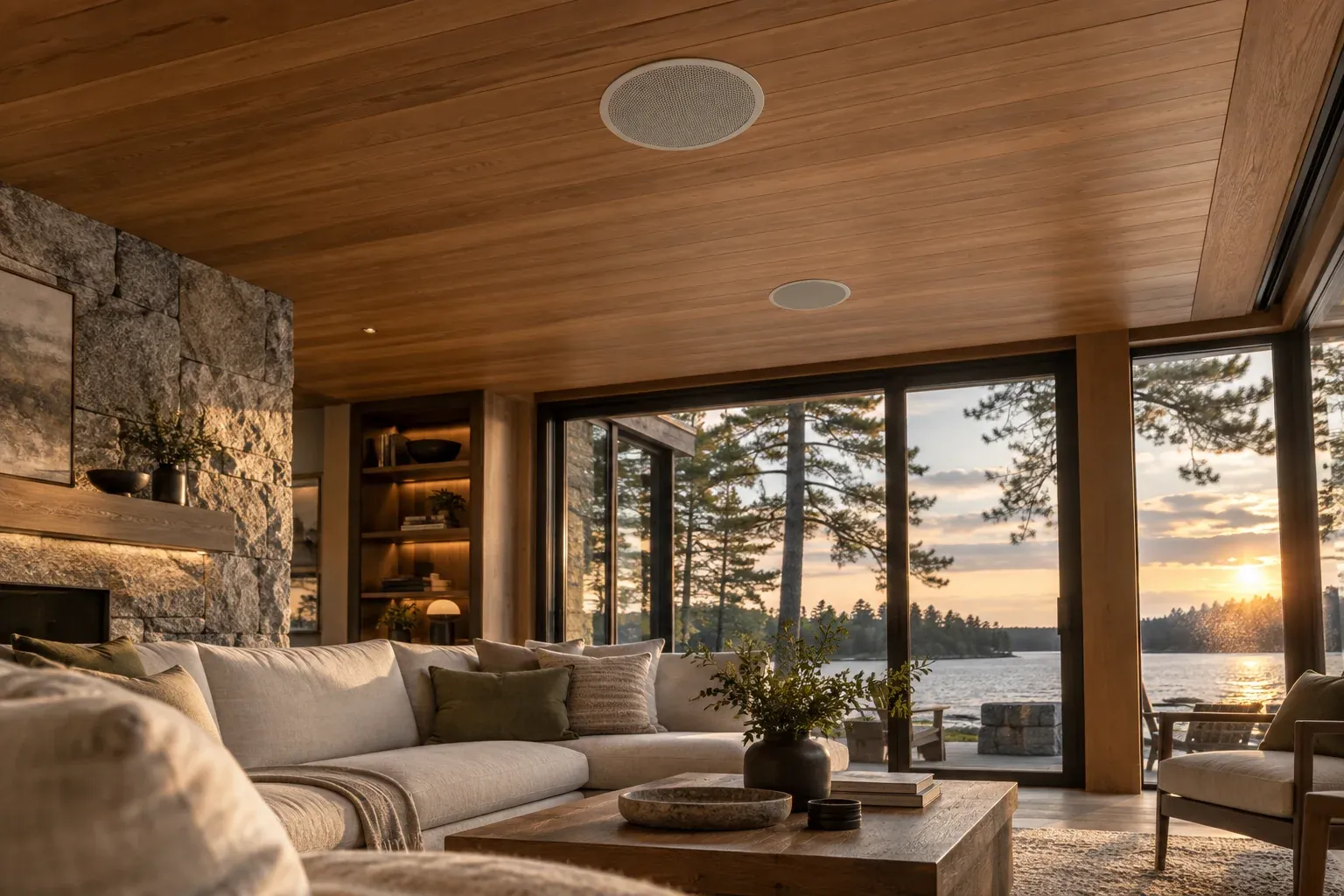
Music changes a room before anyone notices the speakers. A quiet playlist in the kitchen. Something warmer over dinner. A different album upstairs while the rest of the house settles in for the evening.
An interior audio system earns its place when those choices feel natural. For a custom home or cottage in Muskoka, that means planning sound with the same care as lighting, furniture, and the view. The equipment should serve the room, and the controls should be easy enough to use every day.
Start with listening zones
A zone is an area you can control independently. It might be one room, several spaces that function together, or a particular listening area within a larger home. It is not the same thing as the number of speakers.
CEDIA’s introduction to multi-room audio describes the central choice: playing the same programme across spaces or listening independently. The design work is deciding where those choices belong in your home.
Imagine an ordinary weekend. You may want the kitchen and dining room grouped for lunch, then separated while someone works at the dining table. Bedrooms usually benefit from their own control. A guest suite should be simple for its occupants to use without changing what everyone else hears.
Mark the rooms on a floor plan and note three things beside each: who listens there, whether it needs independent volume, and what other rooms it should join. This short exercise gives the audio design a much stronger foundation than specifying a speaker in every ceiling.
Choose speakers for the room and its architecture
In-ceiling speakers can be visually quiet, particularly when their positions align with the lighting and ceiling details. In-wall speakers offer another architectural option. Freestanding speakers may be the right choice for a room where focused listening matters most.
The least visible solution is not automatically the best one for every space. A tall great room, a low-ceilinged study, and a long kitchen have different listening positions and surfaces. Speaker placement should respond to where people sit and move, as well as to what looks balanced on the drawings.
Discuss the finish early. Grille size, colour, nearby lighting, beams, and access above the ceiling all influence what is possible. If a concealed or plaster-in speaker is proposed, confirm its construction requirements, finishing sequence, and service approach before the wall or ceiling assembly is finalized.
Give comfortable volume as much attention as loudness
A good dinner soundtrack should feel present at the table without becoming tiring for the person sitting nearest a speaker. That is a useful design brief. “As loud as possible” usually is not.
Ask the designer to consider the whole listening area. In a large room, distributing sound thoughtfully can be more comfortable than asking a small number of speakers to cover every seat. In a dedicated music room, a carefully arranged stereo pair may be more appropriate.
Hard finishes, generous glazing, and high ceilings deserve attention too. Talk through the room’s furnishings and acoustic character before assuming more amplifier power will solve the experience. Final listening adjustments should happen when the room is substantially furnished, using music you know at the volumes you actually enjoy.
Make your phone a familiar control
Before choosing a streaming platform, name the services and devices your household uses. Then confirm that the exact proposed equipment supports the experience you expect: selecting a room, changing volume, grouping spaces, and handing control to another family member.
Some systems support playback from familiar music apps through compatible streaming protocols. Others rely more heavily on a dedicated control app. Device, service, and subscription requirements should be checked for the selected system. The useful demonstration is your phone playing your music in the intended room.
Room names matter. “Kitchen” and “Primary suite” are easier to understand than amplifier channel numbers. So does the stop button: a guest should be able to lower or stop the music without asking how the home works.
For broader routines, consider how audio will fit into your home automation plan. A physical control for a favourite scene can be a welcome option when a phone is charging elsewhere.
Keep television sound in the conversation
If the great room includes a television, decide whether its speakers will also play music. This affects speaker placement, source connections, controls, and expectations for dialogue.
Whole-home music and television sound have different demands. Ask how lip sync will be handled, what happens when the television turns on, and whether TV sound can be shared with another room. Those capabilities depend on the proposed hardware and connections; they should be demonstrated, not assumed.
You may prefer a distinct TV system in the great room with separate architectural speakers for the rest of the home. The right choice is the one that makes each activity easy without asking the household to manage a complicated sequence of inputs.
Plan the wiring and the equipment space together
Built-in audio requires somewhere for the supporting equipment to live. Allow for power, ventilation, service access, and network connections, alongside labelled speaker wiring. A cabinet that looks generous on a floor plan can become difficult to service once every shelf is full.
Agree which future rooms are worth preparing now. Running a planned cable or reserving a pathway during construction can preserve options for a later phase. Record those routes so the next installation does not begin with a search behind finished surfaces.
This is where an electrician who specializes in structured cabling and its connected devices brings a useful combination of skills. The speaker location, wiring route, amplifier arrangement, and controls can be considered as one installation. At Lume, we connect those practical decisions to the experience you want in the finished home.
Bring us your floor plan and listening preferences. A conversation before the ceilings close can make the finished system much easier to integrate.
What should be included in the proposal?
Ask for the proposed zones, speaker positions, visible finishes, supported music sources, and control options. The quote should also explain the wiring, equipment location, setup, and handover. These details make two proposals meaningfully comparable.
At handover, try a few ordinary moments: start music in the kitchen, join the dining room, change the bedroom volume independently, and stop the whole system. Then repeat with another household member’s phone.
If music is also part of life on the terrace, plan the connection to your outdoor audio system now. Indoor and outdoor areas can share a familiar experience while retaining separate volume and control.
Questions homeowners ask
Can whole-home audio be added to an existing cottage?
Often, yes. The approach depends on access through ceilings, walls, crawlspaces, and existing cable routes. A site review can identify where built-in speakers are practical and where a less invasive option makes more sense.
Can different rooms play different music?
A suitably designed multi-zone system can provide independent sources and volume. Confirm the number of simultaneous streams, supported services, and account requirements for the proposed equipment.
How much does interior audio cost?
The main variables are the number of independent zones, speaker type and quantity, installation access, amplification, controls, and any TV integration. A room-by-room scope is a better basis for a budget than a price per speaker.
Considered for your property
Let’s plan the sound of home.
Tell us where you listen, how you entertain, and what you want to keep out of view. We’ll help shape a system around those rooms.
Discuss your interior audioBased in Bracebridge. Serving Muskoka and its lake communities.