
Structured cabling
A network starts with what’s behind the walls.
Commercial data cabling, racks, and pathways installed with care, tested, and documented. A dependable foundation for the systems your building uses every day.
Discuss your project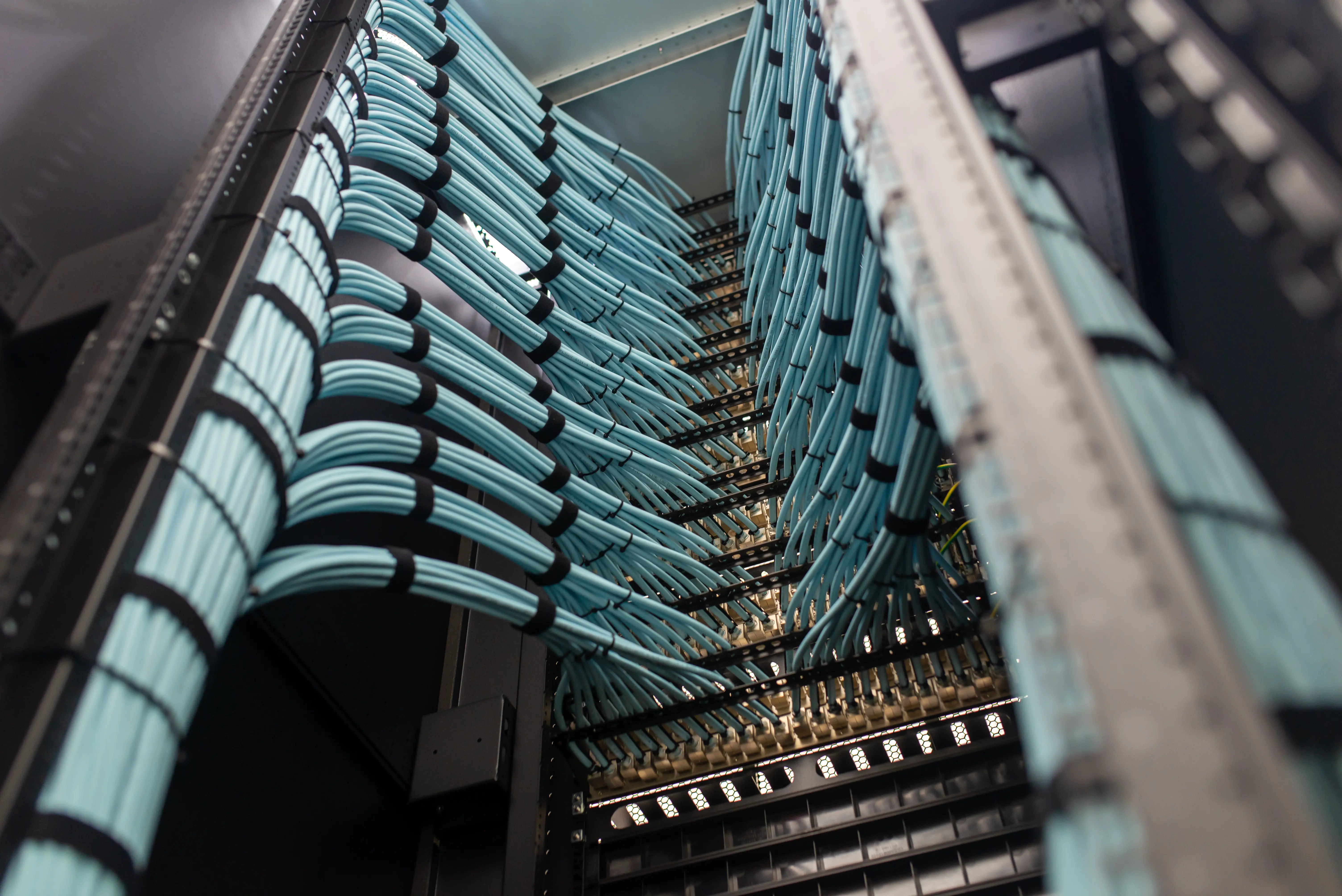
In plain English
The physical connections behind your technology.
Structured cabling connects desks, payment terminals, cameras, and wireless access points back to your network. An organized system makes faults easier to trace and future changes easier to plan.
When to bring us in
- A new building, fit-out, or renovation
- An overcrowded or undocumented network closet
- New devices, additional outlets, or unreliable connections
A detail that matters
A connection test is not a certification test.
A cable can connect and still fall short of its specified performance. Agree the cable category, permanent-link or channel test limits, and labelled result files before installation.
Pathways & racks
Cable management, trays, ladder rack, grounding, and patching layouts that keep closets clean and serviceable.
Copper & terminations
Cat5e, Cat6, and Cat6A runs installed with bend radius, separation, and labeling discipline, ready for moves/adds/changes.
Switching readiness
Power, patching, and labeling prepared for edge switches, VoIP, and WiFi devices with documented port maps.
Delivery approach
Built to be supported
We plan labeling, patching, and pathways up front so site staff, remote IT, and future trades know exactly what was installed and why. If a project needs licensed or listed partners, we coordinate them into the schedule.
What you receive
- Cable schedules, labeling schemes, and patching plans that match what is in the rack.
- Certification results and photos stored in an organized closeout package.
- Documented pathways, penetrations, and grounding so future trades know what is in place.
- Clear escalation and service process for ongoing support.
Related services
Services built on the same foundation
Fiber Optics
Backbone and uplink work when closets, distance, or capacity need fiber instead of copper alone.
WiFi
Access point cabling, surveys, and deployment readiness built on the same labeling standards.
VoIP
Voice rollout support where switching readiness, PoE, and patching need to be aligned first.
Onsite Support
Field remediation, MACD, and cleanup when the closet or floor needs accountable hands onsite.
Cabling & Network Infrastructure FAQ
Before installation begins
Cat5e vs Cat6 vs Cat6A, what should we install today?
Choose the cable category against the intended application, route length, device power needs, and environment. Existing Cat5e may suit current requirements. Cat6A is commonly specified for 10GBASE-T over a full-length channel. The installation and test specification matter as much as the cable label.
How long can an Ethernet cable run?
A common structured copper design has a 90-metre permanent link and a 100-metre channel including patch cords. Application, temperature, and cord construction can impose further limits. Longer routes may need a different distribution layout or fiber.
What speeds do we actually need?
Many businesses run well on 1Gb to the edge with faster uplinks between closets. High density WiFi, heavy file workflows, and larger camera systems can justify faster links in specific places.
Can Cat6 do 10Gb?
Cat6 can support 10GBASE-T on shorter links under the relevant installation conditions. Do not assume it supports that application at the full 100-metre channel length. We review the intended equipment, length, and crosstalk conditions before recommending reuse.
Can you reuse existing cabling?
Sometimes. We can test what is in place and tell you what is worth keeping, what needs remediation, and what risk exists if you leave it as is.
Plenum vs riser cable, what is the difference?
It is about where the cable is allowed to run. Plenum cable is used in certain air handling spaces. Riser cable is used in vertical runs between floors. Requirements depend on the building and local code, so we spec cable types to match the environment.
Do we need shielded cable or unshielded?
Most office environments work well with unshielded cabling when it is installed properly. Shielding can help in higher interference areas, but it also requires the right grounding and hardware choices. We recommend it only when it is actually needed.
What does a good closeout look like?
Labeling that matches a logical scheme, a port map, test results, and updated as builts. If someone had to service it next year, they would not be guessing.
Have a site-specific question? Send it over. Or read what structured cabling actually means in practice.
In the field / JD Sports
Infrastructure behind new store openings.
Lume works directly with JD Sports New Store Opening and IT teams, coordinating drawings, materials, installation, testing, and handoff.
Let’s work through it
Let’s talk about structured cabling.
An upcoming project, a recurring problem, or a plan that needs a second set of eyes. Start with what you know. We’ll help clarify the next step.